
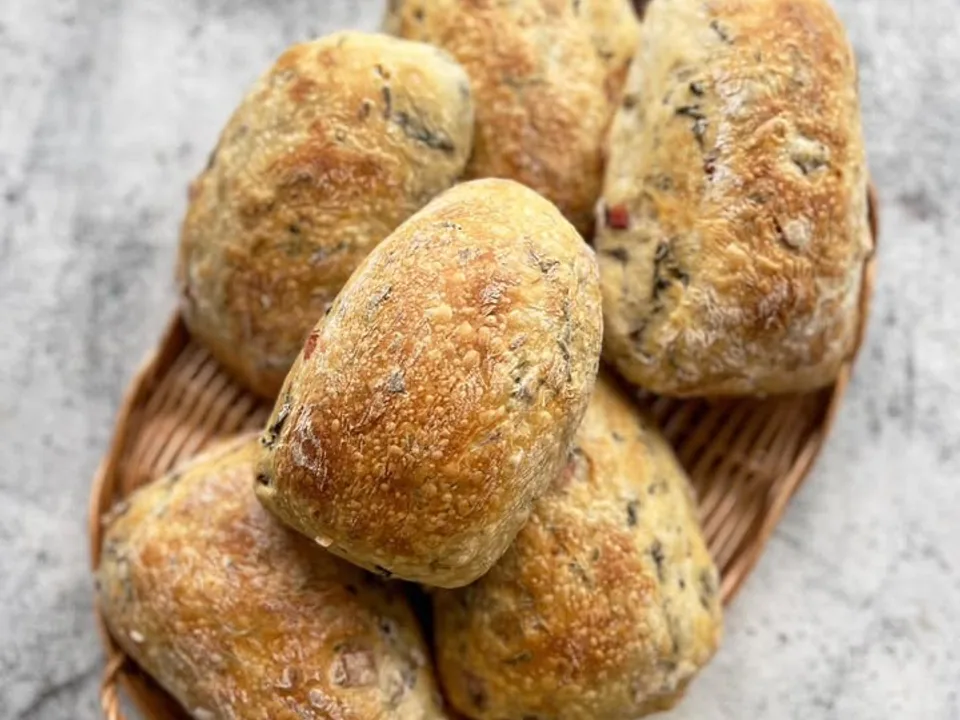
Preserved Mustard Green and Bacon Ciabatta
Preserved Mustard Green and Bacon Ciabatta. Source quantities and method are retained, with explicit editorial sharing, scheduling and handling notes.
Recipe information
- Category
- Bread
- Cuisine
- Chinese-Western fusion
- Keywords
- ciabatta · slipper bread · preserved mustard greens · bacon · levain · high-hydration bread
Ingredients
Tap an ingredient for prices- Main dough350 g
- 100 g
- 200 g
- 50–60 g
- 5 g
- 3 g
- 18 g
- Fillingas needed (no amount given in source)
- as needed (no amount given in source)
- a little (no amount given in source)
- ShapingAs needed (amount unspecified in source)
Method
Cold autolyse
Mix the bread flour and water, then cold-autolyse for 30–60 minutes.
Add levain and fresh yeast
Add the levain and fresh yeast to the autolysed dough and mix to a smooth dough; add the salt and mix until even.
Bassinage and olive oil
Add the bassinage water in stages, mixing until absorbed; finally add the olive oil and knead until even.
Cook greens and bacon
Cut the bacon into pieces and pan-fry to render the fat. Soak the preserved mustard greens until soft, wash them, and stir-fry with the rendered bacon fat and a little minced garlic; set aside.
Add filling and fold
Transfer the dough to a proofing box and spread it flat; rest 30 minutes, then spread the cooked greens and bacon evenly over it and do one full fold. After that, fold once every 30–40 minutes for 3–4 folds in total.
Cold fermentation
Cold-ferment for about 12–15 hours until about tripled in size with an obviously gassy dough.
Divide and shape
Dust the work surface (a proofing cloth underneath is better), turn the dough out, gently square up the corners, stretch into a rectangle and cut into 6–8 equal portions.
Room-temperature final proof
Gently tidy the edges of each piece and gather it toward the centre; place them spaced apart on a proofing cloth and proof at room temperature for about 30–40 minutes, then transfer to a baking tray.
High-temperature bake
Preheat the oven to 230°C and bake for about 18–20 minutes. The source gives no internal temperature, so check for doneness yourself. Cool briefly before serving.
Editorial notes
Editorial plan: the full formula is planned for 8 people sharing. Preparation 1145 min =45 active +1100 waiting; heating 60 min; total 1205 min. Waiting: 30 min greens soaking,60 autolyse,120 folding,720 cold retard,40 final proof,130 cooling. Heating: 10 min filling frying +30 preheat +20 bake. Portions and durations absent from the source are editorial scheduling estimates, not a new kitchen test or guaranteed timing; judge by actual condition and doneness. The 200 g initial and 50–60 g reserved waters are retained separately, not another 250 g addition. Both 100 g prepared levain and 3 g fresh yeast are actually listed in the source.Greens soaking is estimated at 30 minutes because the source gives no duration. The old dated class promotion is excluded from current bookings/offers. The source 12–15 h cold ferment is preserved;12 h is scheduled, with longer routes additional.
May contain allergens (for reference; please check yourself)
- Gluten
