
Recipe information
- Category
- Pretzel rolls
- Cuisine
- German-inspired baking
- Keywords
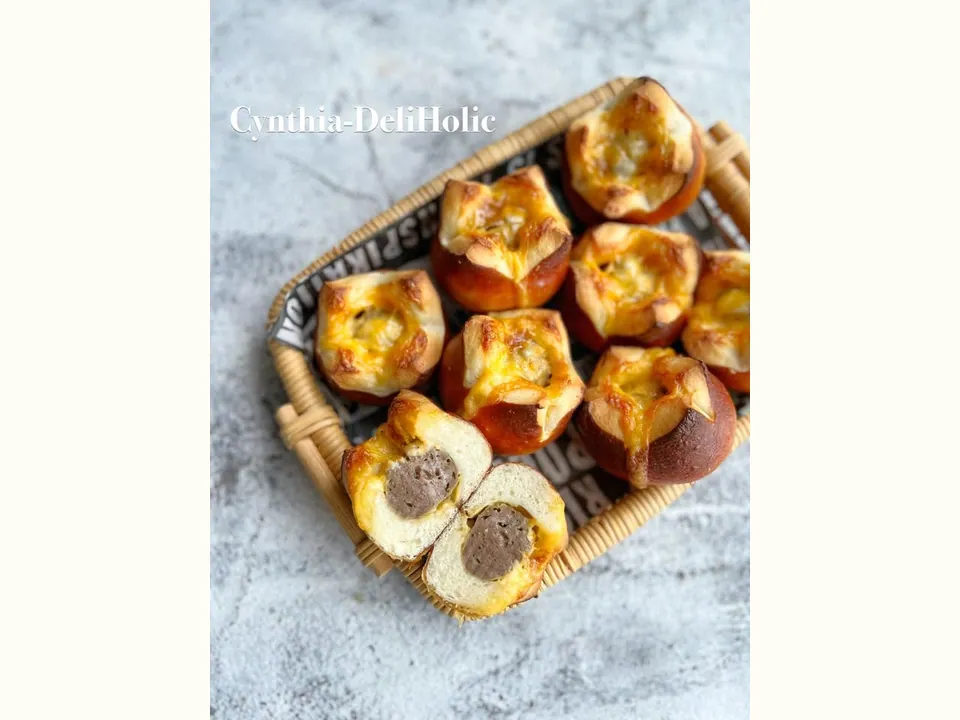
- Cheese and Beef Meatball Pretzel Rolls
Ingredients
Tap an ingredient for prices- Dough300 g
- 10 g
- About 165–175 g
- 3 g
- 3 g
- 15 g
- Filling11 small meatballs that fit fully inside (editorial quantity)
- 55 g, about 5 g each (editorial suggestion)
- Dipping bath, not a consumed liquid portion500 g for the dipping bath
- 15–20 g, only if this ratio is supported by the product directions
Method
Knead dough
Mix the dough ingredients except salt and butter and knead to an initial membrane. Add salt and butter and knead smooth to a strong, thicker membrane.
Divide and chill
Divide into pieces of about 45 g; the source yields about 11. Water varies, so use actual dough weight rather than forcing an excess count. Round and refrigerate to rest 20–30 minutes.
Fill the rolls
Flatten and degas, enclose a small fully cooked meatball and cheese in each and seal tightly. The source optionally freezes for 30 minutes to ease dipping and cutting.
Prepare bath safely
Editorial safety note: clear the work area, keep children and pets away, wear eye protection and lye-resistant gloves and work with ventilation. Use manufacturer-specified lye-compatible non-reactive containers and tools, never aluminium. Follow the product directions: start with cold water, add food-grade lye slowly without splashing and let the solution cool. Use the source 15–20 g per 500 g water only where supported by that product; do not substitute chemicals.
Dip and cut
With suitable tools, dip cold dough for about 20–30 seconds, avoiding skin contact, drain excess and place on a suitably lined baking tray. Cut a small cross on top about 1–1.5 cm across without opening too widely.
Bake thoroughly
Preheat to 190–200°C and start with about 12–15 minutes, adjusting for oven, filling and dough size until bread is cooked through and the filling is thoroughly heated at the centre. Surface colour alone is not sufficient.
Editorial notes
Scope and portions: the source yields about 11 rolls; sharing among 6 is an editorial scaling base. Eleven small fully cooked beef meatballs and 55 g cheese are editorial filling quantities, not source amounts. The source explicitly identifies Brezen Dip as mainly sodium hydroxide; it is not mooncake kansui or baking soda. This edition applies only to a verifiable labelled food-grade baking product. Do not follow this procedure if its directions do not support the use or concentration.
This edition does not repeat claims of harmless conversion, guaranteed intestinal safety or irreplaceability. The bath remains corrosive and must not be drunk. Handle leftovers and cleanup according to the product and local disposal instructions rather than pouring them away indiscriminately. Stop if suitable equipment or clear food-grade product instructions are unavailable. Check the actual meatball, cheese and milk-powder labels: they may contain additional wheat, soy, egg or other allergens not specified in the source. Existing flags do not guarantee the absence of other allergens.
May contain allergens (for reference; please check yourself)
- Gluten
- Milk

