
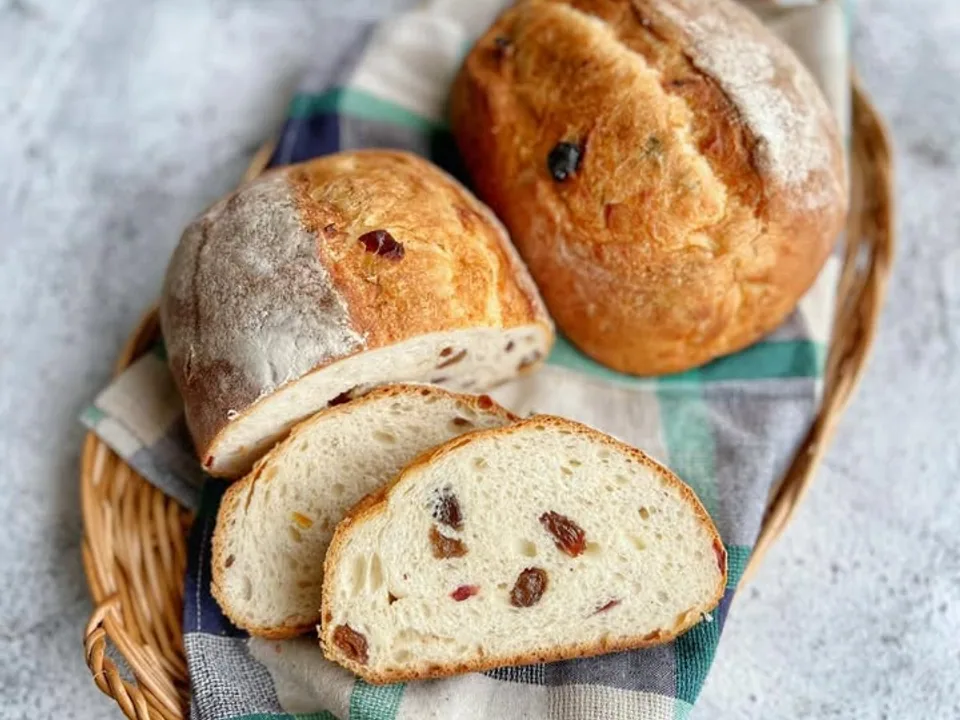
Soft European Bread with Sponge Preferment and Dried Fruit
Soft European Bread with Sponge Preferment and Dried Fruit. Source formula and method retained, with explicit editorial sharing, scheduling and ingredient-handling notes.
Recipe information
- Category
- Bread
- Cuisine
- European-style bread
- Keywords
- sponge preferment · soft European bread · dried fruit · Napoleon flour · steam baking · DeliHolic
Ingredients
Tap an ingredient for prices- Sponge preferment250 g
- about 170–180 g
- 3 g
- Main dough100 g
- 25 g
- 10 g
- about 55–60 g
- 3 g
- 25 g
- Inclusion60–80 g
- Surface (no amount given in source)As needed (no amount given in source)
- A little (amount unspecified)
Method
Mix the sponge
Sponge preferment: mix the Napoleon flour, water and yeast into a smooth dough.
Ferment the sponge (cold or room temperature)
Ferment the sponge in the refrigerator for 12–16 hours; if in a hurry, ferment at room temperature for 2–3 hours instead.
Add main dough ingredients and dried fruit
Add the main dough ingredients (except the dried fruit) and knead well, then add the boozy dried fruit last and knead just until evenly combined.
Bulk ferment until doubled
Round the dough and bulk ferment until doubled in size.
Turn out and divide the dough
Turn the dough out and divide into the portions you need (the author divided it into two portions of about 350 g each to suit her banneton size). Source note: no banneton is fine — you can shape and proof directly.
Degas and shape
Degas the dough and roll it into a tongue or rectangle shape, flip it over, roll it up into an olive or cylinder shape and pinch the seam firmly closed.
Final proof in banneton or on tray
Place it in a flour-dusted banneton (it will be turned out after proofing) or directly on a baking tray, and proof until 2–2.5 times its original size.
Dust, score and dab with butter
Dust a little flour on the surface, cut one score, and dab a little butter into the score.
Bake at 210 °C
Bake at 210 °C for about 20–30 minutes, adjusting for the size of each loaf; after baking, judge doneness by the actual oven and browning, and extend the bake if not cooked through. Source note: adding steam during baking gives a better result and a larger finished volume.
Editorial notes
Editorial plan: the full formula is planned for 6 people sharing. Preparation 1030 min =40 active +990 waiting; heating 40 min; total 1070 min. Portions and durations absent from the source are editorial scheduling estimates, not a new kitchen test or guaranteed timing; judge actual condition and doneness. Waiting:720 min source minimum12h cold sponge,75 estimated bulk,75 final proof,120 cooling. Heating:10 preheat+30 bake. Subsequent fermentations are not hidden inside active time. The source2–3h room-temperature sponge is an alternative, not mixed into this cold route. Use60–80g prepared soaked fruit. Finishing butter is required in the source method.
May contain allergens (for reference; please check yourself)
- Gluten
- Milk

